Archive | Uncategorized RSS feed for this section

AAAP Booth at ASP Conference

9 Jun

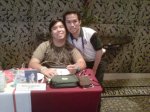
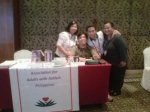
The ASP conference held last April impacted many lives especially amongst families whose member(s) are diagnosed with autism. In the conference, AAAP held a booth exhibit of its paraphernalia to campaign the new organization to adults with autism families and to the general public. Our AAAP champions Vico Cham and Carlo Veluz whose mothers Cathy Cham and Mona Veluz are present during the conference. Mona Veluz was guest speaker too. Cathy and Vico got to meet the Mayor of Carmona, Dahlia Loyola who was the force behind the set up of a PWD Rehab Center in Carmona, Cavite in partnership with DSWD. We recognize the laudable efforts of individuals or public servants who put the welfare of people with disabilities in their agenda… Thank you!
Figure 1 : (Vico Cham & Carl Veluz)
Figure 2 : (Vico with Mayor Dahlia Loyola of Carmona, Cavite)
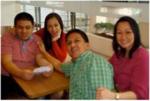
Figure 3 : (Mother & Son tandem – L-R : Cathy Cham, Vico Cham, Carl Veluz & Mona Veluz)

ASSISTED LIVING

9 Jun

AAAP aims to provide autistic adults with a residential community that gives them a safe, productive and independent life…

by KATRINA ONG
Photographs by Tinee De Guzman
Other photos courtesy of AAAP

PARENTING isn’t a walk in the park, and for some parents who have to take care of their adult child with autism, it presents a whole new challenge. “Last Holy Thursday,a my son and I went to Shakey’s to order pizza. The number of people overwhelmed him, and so he started hitting and biting me,” says atty. Jun aragon. Entrepreneurial couple Paul and Laurie Tayag share their own story. “We got bumped off the Detroit airport because our son beat up an airline passenger,” a giggling Laurie says about their 33-year-old son, Glenn. Light as their mood may be when they tell these stories, these parents understand that their children’s mishaps are part of an urgent, much bigger socialization problem that the country needs to address. Hence, in July 2008, they, together with other parents of individuals with autism, established an organization called associa- tion of adults with autism, Philippines (aaaP).
A special community
Based on autism Pinoy studies, autism is the fastest-growing developmental disability, affecting approximately 1 in 150 children. Everyday, 67 children are diagnosed with it.
AAAP is a non-profit organization dedicated to the long-term care of adults within the autism Spectrum Disorder (ASD), a wide severity spectrum of conditions characterized by social and communicative deficiencies, repetitive behavior, and cognitive delays. aaaP’s main project, a Special Place, aims to build the country’s first residential community that will provide social interac- tion and enrichment growth to these adults.
The whole idea was brought to the country by AAAP president, Lirio Sobrevinas-Covey, a professor of clinical psychology and senior research scientist at Columbia University in New york. Her 33-year-old son Mikey lives in a residential community in New york. Her personal vision for AAAP is “to establish a safe and secure environment for adults with autism in the Philippines, an environment that will enable them to live amidst their peers and independently of their families by providing them with appropriate educational, vocational, social, and medical services so that they can grow and sustain themselves to live a wholesome and happy life.”
The organization has acquired a one-hectare land in Lipa City as its first village site. The location is flood- safe and has a cool climate. “Our goal is to build six cottages that can house six residents and a house parent each,” says AAAP board director Cathy Cham. “But for now, we want to start with at least three cottages first.” In addition to the houses, an administration building will also be built for the staff, along with housing and workshop facilities, such as a kitchen for cooking, a small theater for music and arts, and a gym for physical activities. The village prototype follows the farmstead model, a popular model in Europe, which requires a big area for nature therapy, and recreational and agricultural activities like planting.
For this first village, AAAP targets residents 18 years old and up, who are within the mid functioning level of autism. The autism spectrum ranges from light, mid-functioning, to severe levels. mid-functioning autistic adults are those who are under home program due to socialization difficulties, but who still have a big chance to develop as a functional adult. Eventually, AAAP will also develop communities for the other levels.
The initial goal of AAAP is to raise PHP 30 million for the construction of the village. Once it’s built, AAAP will proceed to the second part of its program: raising endowment funds. The endowment program includes looking for sponsors who will pay for the living costs of
residents whose families cannot afford it, and collect financial support to keep the village continuously operating. The payment scheme will run like a discounting system, where people can pay per installment.
A productive life
Whereas residential communities for adults with autism have long existed in other countries such as the U.S. and even in the middle East, the aaaP community will be the first in the Philippines. “The current problem in our country is that existing facilities only believe in early intervention,” says Cham. “So they only accept the young ones.” The purpose of a Special Place is to take care of adults with needs different from those of the young ones. As Covey puts it, “Emotionally and psychologically, autistic adults need to be more on their own, and prefer spending more time with their peers than their families or parents.”
The parents of AAAP also believe that the community they will build will help the autistic adults develop their productivity and gifted skills, debunking the common mentality that people with this condition have no capability. In fact, Vico and Matthew, the sons of Cham and Aragon respectively, are gifted artists whose paintings were featured and mostly sold during the AAAP launch, an art auction held last February 20 at the Filipinas Heritage Library in Makati. They prove that with the right developmental process, individuals with autism can also excel in particular activities.
Lastly, AAAP stresses the importance of family support as an integral part of the development of these adults. “What we don’t want to happen is for parents to just pay for the living costs, and then leave their child in the community forever,” says Aragon, legal counsel for AAAP. “They have to at least visit them monthly. We want continual involvement with the parents.”
Raising PHP 30 million, and the endowment funds to follow, is a huge challenge for AAAP. Laurie Tayag speaks on behalf of all the parents who share the same concern: “We are getting old, and when the time comes that we’re not here to take care of our son, who will? We worry for his future. That’s why we need to make this happen. It’s about time we create this community.”
“What we have now is a vision, we need the funds to actualize it,” Paul Tayag says, addressing the public.
With the participation of institutions and society at large, Covey and the AAAP organization can help autistic adults “live productive lives for themselves as well as for the larger community.”.
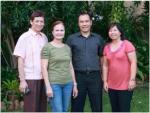
Figure 1 : (L-R :AAAP parent members Paul Tayag, Laurie Tayag, Legal Counsel Jun Aragon and Director Cathy Cham)
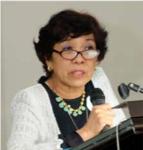
Figure 2 : (AAAP President, Lirio Covey giving a speech during the launch last Feb 20 at FHL, Makati)
Figure 3 : (Other AAAP members with their children with autism — Casano Family)
Figure 4 : (Palomares Family)
Figure 5 : (AAAP paraphernalia that feature the artistic talents of adults with autism, like the calendar displaying the artworks of Cathy Cham’s son, Vico.)

My Angel Nicolo

9 May

By : Melanie Sabino (The Philippine Star, May 8, 2012)
Manila, Philippines – My son Nicolo was born 11 years ago and he was a perfect baby. Always smiling and quiet, he hardly cried. His dad is a quiet man so when his grandmother said something was “wrong” with my son because he didn’t interact with them, I thought it was because he just wasn’t as sociable like his dad.
When his pediatrician, a cousin, said that Nicolo showed signs of autism and he needed to be tested, I took it well. No major reactions and no anxiety. I thought it was just one of those tests. He recently had a hearing test — he didn’t look when we called his name — and there was no auditory problem.
He was two years old and still spoke in gibberish, but then my eldest didn’t speak till she was three either, so it was fine. I said to myself, some kids just develop later than others. My Nicolo walked at nine months! This was no big deal.
The waiting list to see the lone development pediatrician in Bacolod was eight months, so we brought Nicolo to Dr. Joselyn Eusebio at St. Luke’s Hospital. By then, I knew my son was different.
His pedia recommended we give him Benadryl as he was so hyper and maybe more so on the plane. It didn’t work. He wouldn’t sit still and ran up and down the aisle the whole flight.
Dr. Eusebio diagnosed Nicolo with autism. My husband said later he wanted to hit his head on the wall. I was calm. I was relieved it wasn’t mental retardation. At that time, though I had read up on autism, I didn’t know that more often than not, mental retardation was present. Sometimes ignorance can be bliss.
As soon as I heard autism, I went into mom overdrive. I researched, bought books, searched the Net, called doctors. I saw five doctors in one week. It was dismal. The books described the condition but didn’t have one definite working therapy, all sources and resources were not available locally, and the doctors all told me one thing: There is no cure, thus, it’s hopeless.
I was depressed for a whole minute and then I was mad and revved up some more. Those doctors didn’t know what they were talking about. I was talking to the wrong professionals. The books and online articles may be all foreign, but the condition was not; there must be other parents like me here. And then it began — the barrage of people who suddenly “heard” and wanted to help.
A friend from my high school I hadn’t talked to for years called me up and introduced me to her group of parents. She heard about Nicolo from my mother-in-law who is a good friend of her mom’s. I joined their support group online. I was right, those doctors didn’t know anything.
The group was a goldmine of information! I realized then what I know now: Because autism is a fairly “new” condition, not much is known about it, but because our kids can’t wait, we do our own research. Maternal instinct was in full throttle. Moms composed 90 percent of the groups. It is a mother-powered community.
Within a month, I was besieged by calls from parents of children with Autism Spectrum Disorder (ASD). All they wanted to do was help. It was unending, heartwarming, and blessed. God is good. One of my oldest friends had a cousin who had an autistic son. She had her own center! It was one of the first and the best centers in Manila. It was difficult to get in, the waiting list was long, but Nicolo was able to start with them two months after diagnosis. I asked to be trained on how to work with my son and they agreed. We stayed the whole summer.
A week after we got back home, a therapist specially trained in Applied Behavior Analysis (ABA) had returned from a year’s training in the States. He just opened his own center. Nicolo was one of his first students.
My high school classmate’s younger sister was a speech therapist graduated from University of Texas in Austin. I had called my friend two months before her sister even arrived in Bacolod. Nicolo was going to be her sister’s first client as soon as her speech center opened.
I enrolled Nicolo in a school for special kids, but I pulled him out after a month. Someone told me about a former teacher who opened her own school and I enrolled Nicolo with her. Ms. May and I have been friends ever since.
I put Nicolo on the gluten-free casein-free diet (GFCF diet) when only a handful of parents were doing it. He has been on it for almost seven years now. His hyperactivity lessened significantly with the diet. He has been on biomedical therapy for almost the same number of years. I also started him on the Methyl-B12 (cobalamin) or MB12. In less than a month, his verbal skills improved drastically. His vocabulary increased immensely and he spoke spontaneously. I have a video of Nicolo singing a popular song when he hardly spoke a few weeks before. It brought me to tears. It was amazing!
Our cook and the staff at home know what ingredients he cannot eat, so do his siblings even if they began passing him a candy or two last Christmas. Everyone knows how and when to prompt him. He used to crawl under the table when there were more than five people around. Now, he is a very sociable little boy. His siblings, all four of them, introduce him to their friends.
For parents with a child with autism I advise lots of research, a solid support group and nonstop education. Prayers are important also — for your peace of mind and your children’s future. I believe God has planned all of this for me. I have a cousin with Down Syndrome who is the same age as I. I had always thought that my aunt was blessed to have an angel living with her. I had always prayed to God for an angel for my family, and He answered my prayer. He gave us Nicolo. God gives me what we pray for, just not in the way we expect, but it is always perfect. Every time, the surprise is always a joy.
A few years back, I wondered about how to put up a home for children and adults with autism. I recently read about A Special Place, the first residential community in the country for adults with autism. Perfect timing! My two older daughters are in college in Manila and I have some free time. Maybe a new project? I contacted Dr. Lirio Covey, president of the Association for Adults with Autism Philippines (AAAP), and met up with the group. This is exactly what I prayed for.

Figure 1 : A family picture with our orangutan friends Papa, Manang Sarah, Manong Joshua, Manang Erica, Mama, Nicolo, and Manang Maegan.

Figure 2 : Born 11 years ago, my son Nicolo was a perfect baby who hardly cried.

Figure 3 : Nicolo and Manong Joshua get a seal kiss at the Singapore Zoo

God has everything planned. I just go with His flow. God is good all the time.
* * *
A Special Place is the flagship project of the Association for Adults with Autism Philippines (AAA), a non-profit group conceived and established by parents of persons with autism. The association aims to provide sustained enrichment opportunities and long-term care to these individuals as well as offer means to achieve personal growth, social interaction, and a cooperative life among their peers. Visit https://adultautismphil.wordpress.com for more information on A Special Place and AAAP. You may also e-mail adultautismphil@gmail.com.