Archive by Author

Autism Society of the Philippines (ASP) Seminars

22 Jul

Please extend your support to ASP too in the same way you support AAAP. After all, we have a common objective and that is to take care of our PWA children/adults. We are all in this together.

JULY 28 BACK TO BACK SEMINARS
WITH THE SUPPORT OF QUALITY LIFE DISCOVERIES
.

“Vocational Training for Persons with Autism”
9:00-12:00NN
The seminar will center on transition and vocational training concepts, principles, and best practices that will equip participants in creating vocational skills training programs for adolescents and adults with special needs. These will be coupled with hands-on experiences from vocational skills training and life skills training programs. It will likewise discuss the use of the Structured Teaching principle based on the acclaimed TEACCH approach and its role in program implementation. Factors, issues, and concerns related to work transition will be tackled, as well.

“ABCs of Job Coaching”
1:30-4:30 PM
The seminar will focus on supported employment and job coaching concepts, principles, and practices. It will likewise include guidelines, tips, roles, and responsibilities for job coaches in the Philippine setting. The discussion will be paired with the hands-on experiences of The Learning Center, Inc. (TLC)’s On-the-Job Training Program since 2002.

Ms. Maria Yolanda Michelle A. Bautista or Teacher Landa is a BA Social Science (Major in Behavioral Studies) graduate of UP Manila. She finished her master’s degree in Special Education at UP Diliman, Quezon City. Shortly after, she finished a Social Entrepreneurship Training Program for Professionals at Ateneo de Manila University’s School of Government. Teacher Landa is the Curriculum Director of The Learning Center, Inc. (TLC), a non-stock, non-profit special education school for individuals with special needs. She administers the schools internal and external affairs and develops the school’s Special Education curricula. She likewise develops TLC’s vocational skills training curriculum, which focuses on work transition training programs in sheltered social enterprise and community-based settings. Her thesis, “Factors Related to Work Transition for Persons with Special Needs” has been published in the Research Journal in Special Education & Independent Living. She completed the Support System for Persons with Disabilities Course under the Japan International Cooperation Agency (JICA) Training Program for Young Leaders 2011 in Fukui, Japan. Teacher Landa is a staunch advocate of individuals with special needs and has been a resource person for various articles on Special Education and childhood development. She is regularly requested to give lectures on various Special Education topics of interests and publishes her professional recommendations through her “Dear Teacher Landa” advice blog.

Venue: Quality Life Discoveries, 70, 20th Avenue, Murphy, Quezon City
Seminar Fee is inclusive of certificate, handouts and snacks.

Single Seminar Double Seminar
Member Non Member Member Non Member
Pre Register 400 500 700 800
*Until July 25
On Site 500 600 800 1000
Registration

Pre-registered participants may pay to Autism Society Philippines, Metro Bank, Kamias Branch Account # 047-3-04751874-2. Please fax the deposit slip with the name/s of participant/s to ASP office and bring it on the day of the seminar. On-site registrants will be accepted depending on the availability of slots. There will only be 70 slots available. No refund will be given to participants who did not show up on the date of the seminar. For more details, please call ASP at 9266941/9298447.

The ASP Seminar Series serves as a platform to educate Filipino parents and professionals on the various interventions, modalities and theories surrounding Autism Spectrum Disorder. Their application and implementation are left at your discretion. The views and personal experiences of the speakers are of their own and don’t necessarily reflect that of the views of the organization.
DIFFERENT BUT NOT LESS

30 Jun

By JOSEPHINE PALOMARES
June 25, 2012, 3:07pm
Source URL: http://www.mb.com.ph/articles/363391/different-but-not-less
Copyright 2012. Manila Bulletin | All Rights Reserved

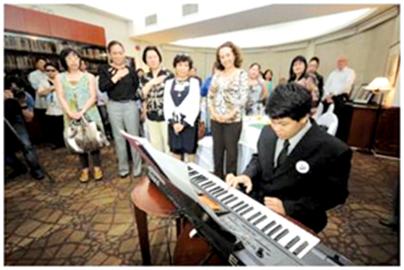
Macky plays the national anthem at AAAP launch
Macky was born pre-mature at eight months old as my doctor has to ‘cut me up’ because I was having pre-eclampsia (hypertension). He was a healthy baby and my first-born at age 34.
When he was two and a half, during a family outing at a theme park, he was so hyperactive – running around the park uncontrollably. He spent the whole day running and staring at anything that moves around. My sister told me to have him checked because he seems ‘weird’. He was non-verbal (old folks would tell you that maybe he is just ‘delayed’ as most boys are) and seemed deaf; did not have eye-contact; and would watch TV sideways.
What could be wrong with him? We brought him to a hospital to have his ear checked. His hearing was ok.
On our first visit to a Developmental Pediatrician, the diagnosis was autism and it was to be a lifelong condition. Of course we did not believe her and continued our rounds of several pediatricians, psychiatrist and psychologist. It was to be the most stressful year of my life.
Several questions arose as to what could have caused it. Is it during my pregnancy? Was it my fault that he was born that way? What did I do? Have I not been a good mother?
Finally my husband and I decided to face it head-on. We gave him all the therapies he needed; but we resolved never to treat him ‘special’. At six years old, Macky is still non-verbal. His speech therapies continued till last year because his therapist had to leave.
I read all I could find out about autism and I joined ASP (Autism Society of the Philippines) and became an active member. I advocated for my son and joined their activities. At ASP, I found out that there are other kids that have multiple disabilities (co-morbid condition with autism). I met Moms who would later inspire me and change my perspective on autism. I realized I am not alone. I was thankful; and counted my blessings.
Macky is now 13 yrs old and highly-functional. He attends a regular school and is fully-included. He is now verbal and plays the piano. He is just like any regular teenager except that he still has some ‘odd’ mannerisms like jumping when excited and looking sideways.
I wish that Macky will be happy and will go about life without so much pain and difficulty. That he will find work and have friends. I hope that when Macky becomes an adult, our society will be more accepting and tolerant of people like them.
“For they may be different, but not less” (quote from Temple Grandin).
A Special Place is the flagship project of the Association for Adults with Autism Philippines (AAAP), a non-profit group conceived and established by parents of persons with autism. The association aims to provide sustained enrichment opportunities and long-term care to these individuals as well as offer means to achieve personal growth, social interaction, and a cooperative life among their peers. Visit adultautismphil.

Figure 1 Different But Not Less : Macky plays the national anthem at AAAP launch

ASSISTED LIVING

10 Jun

AAAP aims to provide autistic adults with a residential community that gives them a safe, productive and independent life…

by KATRINA ONG
Photographs by Tinee De Guzman
Other photos courtesy of AAAP

PARENTING isn’t a walk in the park, and for some parents who have to take care of their adult child with autism, it presents a whole new challenge. “Last Holy Thursday,a my son and I went to Shakey’s to order pizza. The number of people overwhelmed him, and so he started hitting and biting me,” says atty. Jun aragon. Entrepreneurial couple Paul and Laurie Tayag share their own story. “We got bumped off the Detroit airport because our son beat up an airline passenger,” a giggling Laurie says about their 33-year-old son, Glenn. Light as their mood may be when they tell these stories, these parents understand that their children’s mishaps are part of an urgent, much bigger socialization problem that the country needs to address. Hence, in July 2008, they, together with other parents of individuals with autism, established an organization called associa- tion of adults with autism, Philippines (aaaP).
A special community
Based on autism Pinoy studies, autism is the fastest-growing developmental disability, affecting approximately 1 in 150 children. Everyday, 67 children are diagnosed with it.
AAAP is a non-profit organization dedicated to the long-term care of adults within the autism Spectrum Disorder (ASD), a wide severity spectrum of conditions characterized by social and communicative deficiencies, repetitive behavior, and cognitive delays. aaaP’s main project, a Special Place, aims to build the country’s first residential community that will provide social interac- tion and enrichment growth to these adults.
The whole idea was brought to the country by AAAP president, Lirio Sobrevinas-Covey, a professor of clinical psychology and senior research scientist at Columbia University in New york. Her 33-year-old son Mikey lives in a residential community in New york. Her personal vision for AAAP is “to establish a safe and secure environment for adults with autism in the Philippines, an environment that will enable them to live amidst their peers and independently of their families by providing them with appropriate educational, vocational, social, and medical services so that they can grow and sustain themselves to live a wholesome and happy life.”
The organization has acquired a one-hectare land in Lipa City as its first village site. The location is flood- safe and has a cool climate. “Our goal is to build six cottages that can house six residents and a house parent each,” says AAAP board director Cathy Cham. “But for now, we want to start with at least three cottages first.” In addition to the houses, an administration building will also be built for the staff, along with housing and workshop facilities, such as a kitchen for cooking, a small theater for music and arts, and a gym for physical activities. The village prototype follows the farmstead model, a popular model in Europe, which requires a big area for nature therapy, and recreational and agricultural activities like planting.
For this first village, AAAP targets residents 18 years old and up, who are within the mid functioning level of autism. The autism spectrum ranges from light, mid-functioning, to severe levels. mid-functioning autistic adults are those who are under home program due to socialization difficulties, but who still have a big chance to develop as a functional adult. Eventually, AAAP will also develop communities for the other levels.
The initial goal of AAAP is to raise PHP 30 million for the construction of the village. Once it’s built, AAAP will proceed to the second part of its program: raising endowment funds. The endowment program includes looking for sponsors who will pay for the living costs of
residents whose families cannot afford it, and collect financial support to keep the village continuously operating. The payment scheme will run like a discounting system, where people can pay per installment.
A productive life
Whereas residential communities for adults with autism have long existed in other countries such as the U.S. and even in the middle East, the aaaP community will be the first in the Philippines. “The current problem in our country is that existing facilities only believe in early intervention,” says Cham. “So they only accept the young ones.” The purpose of a Special Place is to take care of adults with needs different from those of the young ones. As Covey puts it, “Emotionally and psychologically, autistic adults need to be more on their own, and prefer spending more time with their peers than their families or parents.”
The parents of AAAP also believe that the community they will build will help the autistic adults develop their productivity and gifted skills, debunking the common mentality that people with this condition have no capability. In fact, Vico and Matthew, the sons of Cham and Aragon respectively, are gifted artists whose paintings were featured and mostly sold during the AAAP launch, an art auction held last February 20 at the Filipinas Heritage Library in Makati. They prove that with the right developmental process, individuals with autism can also excel in particular activities.
Lastly, AAAP stresses the importance of family support as an integral part of the development of these adults. “What we don’t want to happen is for parents to just pay for the living costs, and then leave their child in the community forever,” says Aragon, legal counsel for AAAP. “They have to at least visit them monthly. We want continual involvement with the parents.”
Raising PHP 30 million, and the endowment funds to follow, is a huge challenge for AAAP. Laurie Tayag speaks on behalf of all the parents who share the same concern: “We are getting old, and when the time comes that we’re not here to take care of our son, who will? We worry for his future. That’s why we need to make this happen. It’s about time we create this community.”
“What we have now is a vision, we need the funds to actualize it,” Paul Tayag says, addressing the public.
With the participation of institutions and society at large, Covey and the AAAP organization can help autistic adults “live productive lives for themselves as well as for the larger community.”.
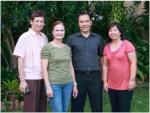
Figure 1 : (L-R :AAAP parent members Paul Tayag, Laurie Tayag, Legal Counsel Jun Aragon and Director Cathy Cham)
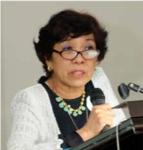
Figure 2 : (AAAP President, Lirio Covey giving a speech during the launch last Feb 20 at FHL, Makati)
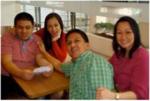
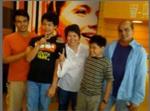
Figure 3 : (Other AAAP members with their children with autism — Casano Family)
Figure 4 : (Palomares Family)
Figure 5 : (AAAP paraphernalia that feature the artistic talents of adults with autism, like the calendar displaying the artworks of Cathy Cham’s son, Vico.)