Archive by Author

DEALING WITH PROBLEM BEHAVIORS IN AUTISM

23 Mar

TIPS FOR DEALING WITH BEHAVIORAL PROBLEMS IN AUTISTIC ADULTS
​ ​

​​B​ehavioral problems can be the autistic person’s response to or expression of distress. Those problems can include compulsive and ritualistic behaviors, noncompliance, disruptiveness, ​irritability, ​or aggression. Caring for a person, adult or child, with autism who exhibits ​difficult behaviors can be challenging. Understanding the whys underlying those behaviors, and making some simple adaptations can help decrease the​ir​
occurrence​.

Some factors that could be the cause of such problems:

​1. ​Autistic persons like schedules, timings, and organization. Routine helps them feel safe and comfortable. Changes in routine can cause a lot of distress.

​2. Persons with autism also experience hunger, thirst, stomach aches, headaches, tiredness, etc. Some may not be able to distinguish all these symptoms from one another, may not understand why they are uncomfortable.

​3. Inability to communicate needs, desires, ​pains ​or discomforts.

​4. Autistic persons have difficulty with social skills. They can feel distress when faced with social demands that are too much for them.

​5. ​Hypersensitivity to or the opposite, a need for more sensory stimulation.

Reducing the occurrence of problem behaviors:

​1. Structure and routine help to make people with autism feel safe and comfortable. Introduce structure through schedules. Whenever there is going to be a change in schedule, make sure the person is prepared for it well in advance.

​2. ​Positive social interactions and family support.

​3. ​Illness​. Consider and assess overall health.

​4. Engage the person in meaningful activities relevant to their sensory need. For example, sports, music, art.

​5. Identify the factors in the environment that cause distress. Eliminate them when possible, or adapt the environment to the sensory need. For example, some may need a dark room​, soothing colors,​
or a quiet environment.

​6. Help the person to communicate better and express their need. Teach the person words that describe what they want. Use picture cards, communication boards, or hand gestures.

Reference: adapted from Sharon Dominica, healthguideinfo.com, 10/27/2010

AUTISM AND GASTROINTESTINAL DISORDER

18 Mar

IS GASTROINTESTINAL (GI) DISORDER A CAUSE OF AUTISM?

Findings from a recent research study found no support for GI disorders as a cause of autism.

GI symptoms do appear to occur in many children with autism and should be clinically evaluated and appropriately treated. The research sample consisted of 111 children with GI symptoms, of whom 61 had been diagnosed with autism and 50 were non-autistic.

Observations of gastrointestinal (GI) abnormalities in autistic children had led to speculations that GI disorders cause autism. Restriction of gluten and casein in diets of persons with autism was a frequent response to that speculation. Gluten and casein free diets are known treatments for celiac disease, an autoimmune disorder of the small intestine. The effectiveness of gluten-free and casein-free diets for reducing symptoms of autism has not been supported by medical research.

Reference: Rafail I. Kushak et al, 2016. Journal of Pediatric Gastroenterology and Nutrition; also, Wolters Kluwer Health, in www.sciencedaily.com/releases/2016/02/160225153612

AUTISM RATES IN THE US – 2014

1 Mar

REPORTED RATES OF AUTISM ARE INCREASING OVER TIME

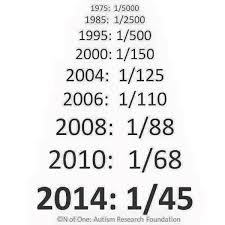
A new (2014) report from the Centers for Disease Control and Prevention and the National Center for Health Statistics, USAfound that 1- in- 45 children or 2.24% of children aged 3 through 17, met the diagnosis of autism spectrum disorder (ASD). This figure is a dramatic jump from earlier surveys, also conducted by the Centers for Disease Control (CDC); 1-in-68 in 2013 and 1-in-88 in 2010.

Changes in the format of the questionnaire may be an important reason for the notable increase.

In previous surveys, the presence of a developmental disability was asked first, rather than the presence of ASD. The new questionnaire flipped the two categories. Not surprisingly, the prevalence of developmental disabilities decreased.

Other findings from the surveys

– High rates of co-occurring conditions – Learning disabilities were the most common (62.6 %); next highest was ADHD (42.8%).

– As previously seen, ASD is almost five times more common among boys than girls: 1 in 42 boys versus 1 in 189 girls. White children are more likely to be identified as having ASD than are black or Hispanic children.

– ASD can be diagnosed as early as age 2 but most children with ASD are diagnosed after age 4.

Comments:

The new survey was based on responses of parents whose children had received medical or special education services. Thus, children who were not receiving those services might have been missed.

This new prevalence figure does not replace the CDC’s 1-in-68 figure seen in a 2011-2013 survey as the official estimate of autism prevalence in the United States.

Survey statistics are estimates and are subject to limitations of sample characteristics. Since ASD can be diagnosed at ages later than 17 years (the upper limit of the recent survey), it is possible this recent estimate could still be an underestimate.

Thus, surveys limited to children younger than age three are likely to produce underestimates. Note that the previous CDC surveys sampled children up to 8 years of age and the most recent (2014) survey which yielded a 1/45 figure was based on children up to 17 years of age.