Restricted, Repetitive Behaviors – a core symptom of ASD
By Lirio Sobrevinas-Covey, Ph.D.
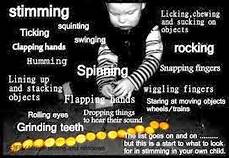
If you live with a person with autism, no doubt you have seen, over and over again, that person engaging in what appear to be unusual behaviors that he/she performs repeatedly, sometimes, obsessively. Like lining up toys, twirling a stick, continuously flapping hands, rocking, jumping or walking in circles. Among infants, there may be repeated jerking of a foot. Among older persons, there may be repeated hitting of one’s body part, that can sometimes cause self-injury. These types of restricted, repetitive behaviors (RBB) comprise one of the core symptoms that make up the diagnosis of Autism Spectrum Disorder (ASD). (The other core criterion of an ASD diagnosis is social interaction and communication deficits).
RBB occurring in the early lives of children can have negative consequences for the person’s development, negatively impacting learning and socialization. Certain RBB, on the other hand, can have positive consequences, such as when the repetition of behaviors results in a highly developed skill that brings satisfaction or vocational success for the autistic person.
Researchers have categorized RBB as lower order or higher order RBB. Examples of lower order behaviors are perseverating manipulation of objects, repetitive movements, some of which can be self-injurious. Higher order behaviors are more complex and are characterized by rigidness and cognitive aspects such as compulsions, insistence on sameness, and circumscribed interests.
RBB are not specific to ASD but occur at higher frequencies and severity compared to other neurodevelopmental disorders (such as Tourette’s syndrome and Obsessive Compulsive Disorder). There is broad heterogeneity among RBB. This heterogeneity may be influenced by genetic factors and underlying neural circuitry. There is not a perfect correlation between dimensions and severity of RBB and the social impairments that also characterize ASD.
What may influence the manifestation and expression of RBB?
– RBB can occur during the person’s early years but is usually well-noticed by others by 2-3 years of age. Lower order RBB tend to be stable over time; whereas higher order RBB can increase in severity over time.
– Lower intellectual ability is associated with lower order RBB; the relation between intellectual ability and higher order RBB is less clear.
– Social communication deficits do not fully account for the expression of RBB found in ASD.
– By implication, interventions focused solely on improving social communication skills may not impact the RBB found in ASD.
Intervention for RBB. Animal research has shown that stereotypical behaviors are more likely to occur in the absence of environmental stimulation. This finding influenced three types of interventions for treating RBB : 1) consequence based interventions that disrupts the RBB-reinforcement relationship, 2) antecedent based intervention that involves modifying the environment to prevent the occurrence of the RBB, 3) antecedent based intervention that enriches the subject’s environment or skills in order to reduce or prevent the occurrence of RBB.
Intervention that focuses on consequences and antecedents of the RBB is compatible with the tenets of Applied Behavior Analysis (ABA) Therapy. Functional analysis, a tenet of ABA, consists of assessing the reasons behind the problem behaviors. Functional analysis seeks to understand whether the RBB attempts to gain attention or to escape internal sensory experiences. Some research has indicated that RBBs serve non-social reinforcement purposes; and, although, this complicates the development of effective, targeted treatment strategies, functional analysis methods, by applying relevant sensory stimulation options, have shown some success .
Reference: Brian A. Boyd, Stephen G. McDonough, and James W. Bodfish, Evidence-Based Behavioral Interventions for Repetitive Behaviors in Autism, J Autism Dev Disord. 2012 June ; 42(6): 1236–1248.


 The Association for Adults with Autism, Philippines is a non-profit association, established by parents of individuals within the Autism Spectrum Disorder (ASD) and professionals dedicated to the welfare of those with this developmental disorder.
 AAAP Today